
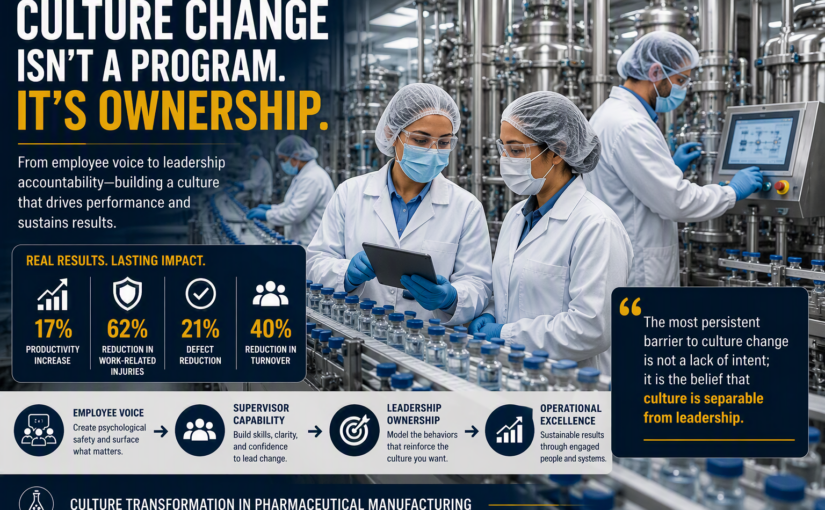
A systems and psychology case study from a pharmaceutical manufacturer with a three-year turnaround.
Published; March 2026, Manufacturing Excellence Magazine
Large organizations often ask for culture change and then treat culture as something that can be outsourced, a program, a vendor, or a series of initiatives. In practice, culture is a system of learned behaviors reinforced by what leaders consistently model, reward, and tolerate. This case study describes a pharmaceutical manufacturer’s multi-year culture transformation that began from the ground up through employee voice and supervisor capability building and then reached a predictable inflection point: leadership initially struggled to “own” the change once the culture improvements became visible. Using evidence-based change principles; psychological safety, readiness for change, participative problem solving, and reinforcement through leader behavior, we helped the client move from consultant-led activity to leader-owned operating routines. Over three years, the company reported a 40% reduction in turnover, a 62% reduction in work-related injuries (relative to the baseline year), a 17% productivity increase, and a 21% reduction in defects, along with an employee-initiated innovation that resulted in a new production line.
The most persistent barrier to culture change is not a lack of intent; it is the belief that culture is separable from leadership. Organizations may hire consultants to “fix culture” while leaving the reinforcement system unchanged, how leaders respond to bad news, how tradeoffs are made under pressure, what gets rewarded, and what gets ignored. When culture improves, leaders sometimes experience an identity threat: success implies new expectations for how leadership must operate. Research on organizational learning, readiness, and defensive routines predicts this pattern, especially in high-pressure environments where the status quo is psychologically safer than uncertainty and where short-term losses are weighted more heavily than long-term gains.
In our experience, organizations with poor culture do not fail to change because they are irrational; they fail because they are human. At scale, the psychological forces that protect comfort, status, and certainty can overpower stated intentions. The following mechanisms are commonly present, and they reinforce one another over time.
This case involves a pharmaceutical manufacturer we refer to as “PharmaMrf” to preserve confidentiality. PharmaMrf was technically strong but culturally constrained. Supervisors spent much of their time in reactive problem solving; employees hesitated to surface issues early; and defects, minor injuries, and process friction were treated as inevitable rather than improvable. Leadership expressed a desire for visible energy, passion, and innovation from managers and supervisors, and they engaged my firm, Ergo-ology, Inc, because our approach treats ergonomics as a people-centered operating system, not a compliance exercise. Our work focuses on bridging the gap between workplace demands and worker capability while improving productivity, quality, and ultimately the culture (Ergo-ology, n.d.-a; Ergo-ology, n.d.-b).
Instead of launching a broad culture campaign, we embedded behavior change into daily work routines and decision pathways. This design choice is aligned with evidence that sustainable renewal emerges from solving concrete business problems and only later aligning formal systems, rather than attempting to change culture through abstract programs (Beer et al., 1990). We combined participative problem solving, supervisor capability building, and leadership reinforcement into a single operating cadence.
At the front line, we implemented mechanisms that made it easy to surface friction points early; especially ergonomic risks and process barriers that were already stealing time and quality. For supervisors, we provided a vision with specific, achievable behaviors and a small set of routines for coaching, escalation, and follow-through. This was designed to increase meaning, competence, autonomy, and impact, all core components of psychological empowerment that predict engagement and proactive behavior (Spreitzer, 1995; Ryan & Deci, 2000). At the leadership level, we focused on readiness and reinforcement: clarifying what change required, allocating time and protection for the new behaviors, and ensuring leaders modeled the responses that created psychological safety (Weiner, 2009; Edmondson, 1999).
The first cultural shift was not visible in presentations or leadership speeches. It was visible in employee voice. Frontline employees began expressing gratitude that their concerns were being heard and acted upon. As psychological safety increased, teams surfaced issues earlier, participated in small experiments, and moved from blame-based narratives to system-based problem solving (Edmondson, 1999).
Next, supervisors emerged as a hinge point. With clearer expectations, practical tools, and small wins, supervisors began shifting from constant firefighting to systematic improvement. This change was reinforced by empowering routines—daily huddles, structured escalation when needed, and visible tracking of actions. Participation matters here: classic evidence shows that involving employees in planning and decisions reduces resistance and improves adoption by building ownership and perceived fairness (Coch & French, 1948).
As energy and joy increased within the focused department, we encountered a predictable paradox: some senior leaders began to question the very behaviors they had asked for. The resistance was not explicit; it appeared as dismissal of “soft” work, reassertion of command-and-control responses under stress, and subtle punishment of voice and experimentation. Psychology offers a coherent explanation. When change threatens identity, status, or certainty, people revert to safer defaults. Status quo bias increases the likelihood of returning to known patterns; loss aversion magnifies the perceived costs of experimentation; and defensive routines protect leaders from discomfort while blocking learning (Samuelson & Zeckhauser, 1988; Kahneman & Tversky, 1979; Argyris, 1990).
This is also a readiness problem. When people observe inconsistent leadership support, their belief in collective capability and persistence declines, even if they value the change. Readiness erodes when resources and situational support are missing or unreliable (Weiner, 2009).
We reframed the turning point as a leadership learning problem rather than a workforce compliance problem. Culture is a pattern of learned behavior. People learn what matters by watching what high-status models do, particularly in ambiguous or stressful situations. This is a basic principle of social learning: observation and reinforcement shape behavior at scale (Bandura, 1977). When leaders responded to truth-telling with curiosity and protection, psychological safety increased; when leaders responded with dismissal or punishment, voice disappeared. The culture followed the head.
The project reached a positive resolution when the senior leader recognized the blind spot: we can desire empowered, innovative supervisors and simultaneously cling to leadership habits that keep people dependent and cautious. Once the discrepancy between intention and impact became discussable, the leader shifted from controlling outcomes to reinforcing the behaviors that produce outcomes. This required reducing defensive routines (making previously undiscussable tensions safe to discuss) and building psychological safety so learning could continue (Argyris, 1990; Edmondson, 1999).
Leadership then owned the change through consistent reinforcement: protecting voice, allocating time for improvement work, aligning priorities, and rewarding learning behaviors—not only end results. By doing so, they increased organizational readiness by strengthening both change commitment and change efficacy (Weiner, 2009). At that point, the culture transformation stopped being “the consultant’s initiative” and became PharmaMrf’s operating system.
Over a three-year period (2022-2025) PharmaMrf tracked operational and people outcomes consistent with a maturing, learning-oriented culture. To make these results easy to scan, we highlighted them below.
This case reinforces a principle that is simple but difficult: culture change requires leader ownership, not leader sponsorship. Bottom-up energy can initiate a shift, but only top-down reinforcement turns local improvement into a stable system. To keep the message concise, we list the most transferable insights below.
We encourage leaders to apply a brief self-audit during moments of pressure, because those moments teach the organization what real culture is.
Argyris, C. (1990). Overcoming organizational defenses: Facilitating organizational learning. Allyn & Bacon.
Bandura, A. (1977). Social learning theory. Prentice Hall.
Beer, M., Eisenstat, R. A., & Spector, B. (1990). Why change programs don’t produce change. Harvard Business Review, 68(6), 158–166. https://hbr.org/1990/11/why-change-programs-dont-produce-change
Coch, L., & French, J. R. P., Jr. (1948). Overcoming resistance to change. Human Relations, 1(4), 512–532. https://doi.org/10.1177/001872674800100408
Edmondson, A. C. (1999). Psychological safety and learning behavior in work teams. Administrative Science Quarterly, 44(2), 350–383. https://www.jstor.org/stable/2666999
Ergo-ology. (n.d.-a). About Ergo-ology. https://ergo-ology.com/about/
Ergo-ology. (n.d.-b). Company Culture Series, Part II: Culture-Based Ergonomics Program (Participatory Model). https://ergo-ology.com/part-2-culture-based-ergonomics-program-participatory-model/
Kahneman, D., & Tversky, A. (1979). Prospect theory: An analysis of decisions under risk. Econometrica, 47(2), 263–291. https://www.jstor.org/stable/1914185
Ryan, R. M., & Deci, E. L. (2000). Self-determination theory and the facilitation of intrinsic motivation, social development, and well-being. American Psychologist, 55(1), 68–78. https://selfdeterminationtheory.org/SDT/documents/2000_RyanDeci_SDT.pdf
Samuelson, W., & Zeckhauser, R. (1988). Status quo bias in decision making. Journal of Risk and Uncertainty, 1, 7–59. https://doi.org/10.1007/BF00055564
Spreitzer, G. M. (1995). Psychological empowerment in the workplace: Dimensions, measurement, and validation. Academy of Management Journal, 38(5), 1442–1465. https://doi.org/10.2307/256865
Weiner, B. J. (2009). A theory of organizational readiness for change. Implementation Science, 4, 67. https://doi.org/10.1186/1748-5908-4-67
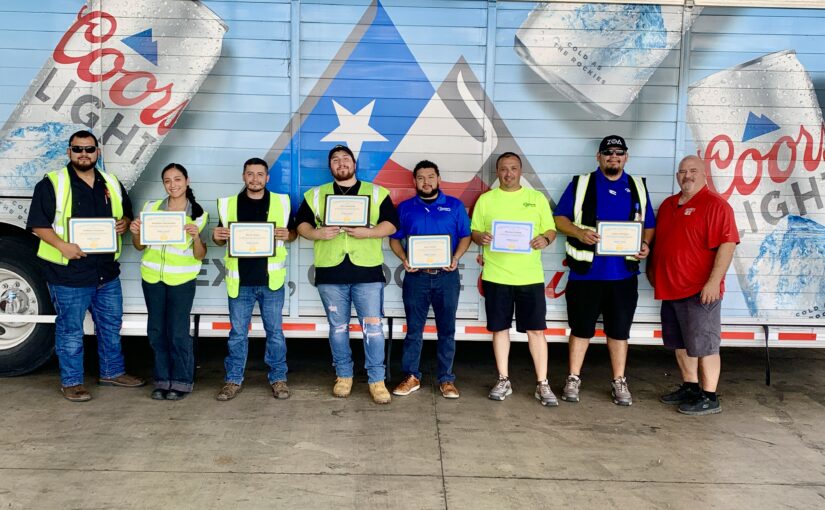
Ergo-ology partnered with Glazer’s Beer & Beverage to address the leading operational risk in beverage distribution: Manual Material Read more
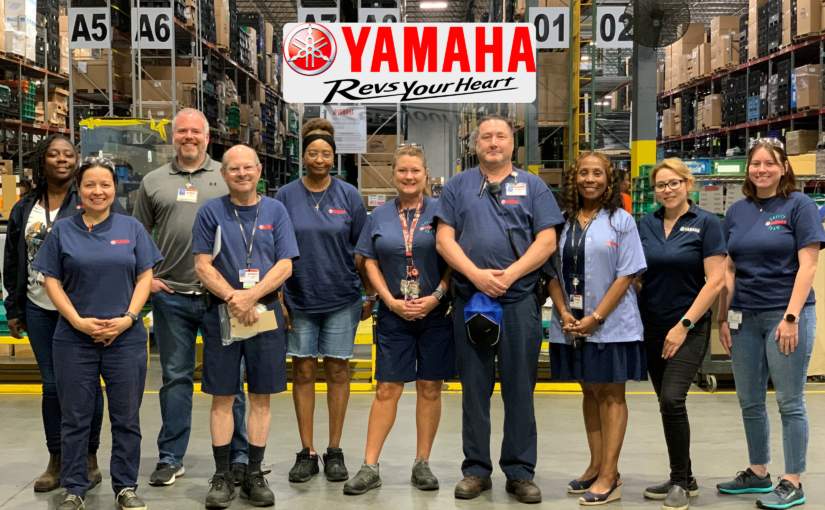
Yamaha leaned into Ergo-ology’s ELP® (ergonomics leadership program) at the start of 2022 with hopes of engaging employees, developing a Read more

We are pleased to announce the United States of America has granted Ergo-ology permissions to certify in #ergonomics with the Read more